- The Dubai mega projects list, line by line
- Where the Dubai mega projects money goes, by theme
- Homes: AED 1.1 trillion for 350,000 units
- Aviation: the second-largest of the Dubai mega projects
- The unglamorous Dubai mega projects: AED 261 billion
- What the AED 2.1 trillion figure does not tell you
- Who pays for Dubai mega projects?
- What Dubai mega projects mean for founders and investors
- The verdict on Dubai mega projects
- Frequently Asked Questions
- Sources
Dubai mega projects worth AED 2.1 trillion are under way, Sheikh Mohammed bin Rashid said on 13 October 2026. Real estate takes AED 1.1 trillion, or about 52 percent. The other AED 1 trillion builds capacity for a bigger city: aviation, power, water, drainage, transport and business districts.
Key takeaways
- Real estate takes AED 1.1 trillion of the AED 2.1 trillion through 2030, with plans for about 350,000 homes.
- Aviation is the second-largest block at about AED 475 billion, more than a fifth of the total.
- Power, water, sewerage and drainage add AED 261 billion, more than the roads, Metro and DIFC lines combined.
The Dubai mega projects list, line by line
Sheikh Mohammed gave the figures at the Mohammed bin Rashid Leadership Forum, Gulf Today reported from WAM. Here is every line, with its share of the AED 2.1 trillion total. No published list we found shows these shares, so they are FOUAE’s own work.
| Project | Value (AED) | Share of total |
|---|---|---|
| Real estate projects to 2030 | 1.1 trillion | 52.4% |
| Emirates and flydubai fleet expansion | 328 billion | 15.6% |
| Power and water grids | 151 billion | 7.2% |
| Al Maktoum International Airport | 128 billion | 6.1% |
| DIFC Phase 2 | over 100 billion | at least 4.8% |
| Roads and Metro Blue and Gold lines | 100 billion | 4.8% |
| Strategic sewerage tunnels | 80 billion | 3.8% |
| Tasreef rainwater drainage | 30 billion | 1.4% |
| Emirates engineering complex | 18.7 billion | 0.9% |
| Dubai Exhibition Centre expansion | 10 billion | 0.5% |
| Blue and Green Spaces Roadmap | 4 billion | 0.2% |
| Not itemised | about 50 billion | 2.4% |
The listed items add up to about AED 2.05 trillion. As a result, roughly AED 50 billion sits outside the published list.
Where the Dubai mega projects money goes, by theme
Group the lines by what they build, and the shape becomes clear. Homes take just over half, while aviation takes almost a quarter. After that come utilities, business districts, roads and green space.
- Homes and real estate: AED 1.1 trillion (52.4%)
- Aviation (fleets, airport, engineering): AED 474.7 billion (22.6%)
- Power, water, sewerage and drainage: AED 261 billion (12.4%)
- Business districts (DIFC, Exhibition Centre): at least AED 110 billion (5.2%)
- Roads and Metro: AED 100 billion (4.8%)
- Green spaces: AED 4 billion (0.2%)
So the headline is, first of all, a housing story. Yet nearly AED 1 trillion goes into the systems a larger population needs, and that half matters just as much.
Homes: AED 1.1 trillion for 350,000 units
Real estate is the largest single line, at AED 1.1 trillion through 2030. According to the announcement, housing plans cover about 350,000 residential units.
The FOUAE calculation
If you divide the headline by the units, you get about AED 3.1 million of project value per home. Treat that as a headline ratio, not a unit price. The AED 1.1 trillion may include land, infrastructure and commercial space as well as homes.
The scale, however, makes more sense against population. Dubai added 332,000 residents in 2025 to reach 4.58 million, WAM reported. Since most homes hold more than one person, 350,000 units can house several years of growth at that pace. That supply wave may also help explain why Dubai rents are now easing for new tenants.
Aviation: the second-largest of the Dubai mega projects
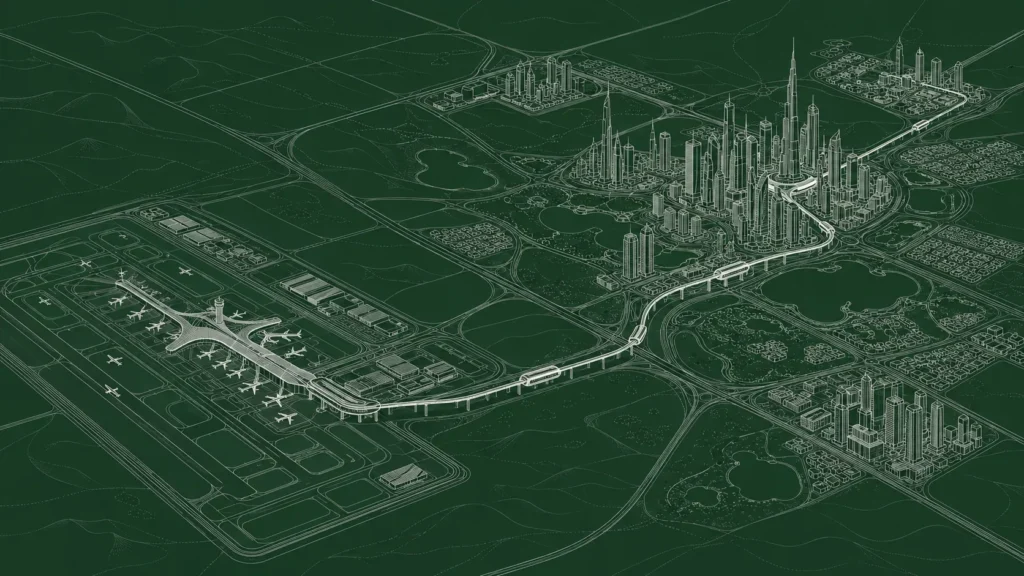
Aviation is the next block. First, the Emirates and flydubai fleet expansion accounts for AED 328 billion. Then Al Maktoum International Airport adds AED 128 billion, and a new Emirates engineering complex adds AED 18.7 billion.
Together that is about AED 475 billion, or 22.6 percent of the total. Notably, the aircraft cost more than two and a half times the airport. Sheikh Mohammed first approved an AED 128 billion passenger terminal plan in April 2024, which appears to be the same figure. The airport is designed for up to 260 million passengers a year.
The unglamorous Dubai mega projects: AED 261 billion
The least visible spending may matter most. Power and water grids take AED 151 billion. Meanwhile, strategic sewerage tunnels take AED 80 billion, and the Tasreef rainwater drainage network takes AED 30 billion.
That is AED 261 billion in all, or 12.4 percent. By comparison, roads, the Metro and DIFC Phase 2 together come to at least AED 200 billion. For scale, the Dubai Metro Gold Line was costed at AED 34 billion in April 2026, WAM reported. In other words, Dubai has earmarked more for pipes and power than for its best-known transport and finance projects.
What the AED 2.1 trillion figure does not tell you
Three caveats help readers use the number well, because a headline this large invites misreading. First, about AED 50 billion is not itemised, although DIFC’s “over AED 100 billion” may cover part of it.
Second, the lines mix timelines. Real estate runs to 2030, whereas most other items carry no stated end date. Third, the total probably mixes public and private money, although the announcement did not say who funds each line.
Who pays for Dubai mega projects?
The announcement did not break down funding, so this section is a FOUAE reading. In Dubai, developers usually fund real estate through sales and their own balance sheets. Similarly, airlines normally buy aircraft from their own budgets and borrowing. Utilities, roads, tunnels and drains, by contrast, are typically run by government authorities.
If that split holds, it matters for readers. Property spending depends on buyers, so it can speed up or slow down with the market. Infrastructure spending, on the other hand, follows government plans and may move more steadily.
Therefore the AED 2.1 trillion is best read as a pipeline of activity, not one government budget.
What Dubai mega projects mean for founders and investors
Follow the second trillion. Utilities, drainage and aviation need engineering, maintenance, logistics and software suppliers for years.
Read the housing line as supply. About 350,000 units will shape rents and yields, so model them in any property plan.
Watch the business districts. DIFC Phase 2 adds office capacity. Meanwhile, the Dubai Exhibition Centre, which hosts GITEX 2026 in December, gets an AED 10 billion expansion.
Sheikh Mohammed put the logic in one line: “Cities that aspire for progress act before others.”
The verdict on Dubai mega projects
In short, Dubai mega projects are half housing and half capacity. The homes draw the headlines. However, the roughly AED 1 trillion in aviation, utilities, transport and business districts decides whether the city can absorb its growth. “Our momentum is continuous and our achievements are ongoing,” Sheikh Mohammed said, and the list shows where that momentum is going.
Frequently Asked Questions
Sheikh Mohammed bin Rashid said on 13 October 2026 that Dubai has AED 2.1 trillion of active projects under way. Real estate accounts for AED 1.1 trillion through 2030, and the rest covers aviation, utilities, transport and business districts.
By value, the largest is real estate at AED 1.1 trillion. Next come the Emirates and flydubai fleet expansion at AED 328 billion and power and water grids at AED 151 billion. Al Maktoum International Airport follows at AED 128 billion.
Dubai’s housing plans include about 350,000 residential units, backed by AED 1.1 trillion of real estate projects through 2030. That works out at roughly AED 3.1 million of project value per unit. It is a FOUAE headline ratio, not a sale price.
Sources
Sources: Sheikh Mohammed bin Rashid, Mohammed bin Rashid Leadership Forum, 13 October 2026, via WAM, Gulf Today, The National and Gulf News; WAM, Dubai population at end of 2025, 2026; WAM, Dubai Metro Gold Line, April 2026; Dubai Media Office, Al Maktoum International Airport, April 2024. Shares, theme totals, the AED 50 billion gap and the AED 3.1 million per-home ratio are FOUAE calculations. Funding observations are a FOUAE reading. This is general analysis, not investment advice.
Founders of UAE (FOUAE) is an independent, digital-first business publication covering the founders, companies and economy of the United Arab Emirates. Follow FOUAE on Instagram and LinkedIn.